The Barnum Effect: Why Generic Traits Feel Personal
The reason generic personality descriptions feel like they were written just for you.
Why ‘Signs You’re Highly Intelligent’ Articles Go Viral
You’ve seen them. “7 Signs You’re Smarter Than You Think.” “If You Do These 5 Things, You’re Highly Intelligent.” They hit millions of views. They get shared thousands of times. And they feel incredibly accurate when you read them.
Here’s the thing, though: these articles tell you what you want to hear, not what’s actually true. They’re built on a psychological trick that’s been known for over 70 years. It’s called the Barnum Effect, and it’s the reason generic personality descriptions feel like they were written just for you.
The Barnum Effect
The Barnum Effect (also called the Forer Effect) describes a simple phenomenon: people accept vague, universal descriptions as uniquely personal. The term comes from P.T. Barnum, the famous circus showman who knew a thing or two about separating people from their money. But the actual research started in 1949.
Psychologist Bertram Forer gave his students identical personality profiles. Every student got the exact same description. The results were embarrassing. Eighty-four percent rated the generic profile as accurate. The average rating was 4.26 out of 5. These weren’t stupid people. They were university students being objectively wrong about something right in front of them.
Why did it work? Our brains process ambiguous information in a specific way. We have a self-serving bias — we want to believe good things about ourselves. When we read something vague like “you sometimes feel restless but generally calm,” we filter for the parts that match our self-image and ignore the rest.
The trick is language ambiguous enough to apply to almost anyone, but specific enough to feel personal. Words like “sometimes,” “often,” and “you prefer” give just enough structure to seem tailored while leaving room for interpretation.
Anatomy of a ‘Highly Intelligent’ List
Now let’s look at how this plays out. Take any “Signs You’re Highly Intelligent” article. Look closely at the traits listed. You’ll notice patterns.
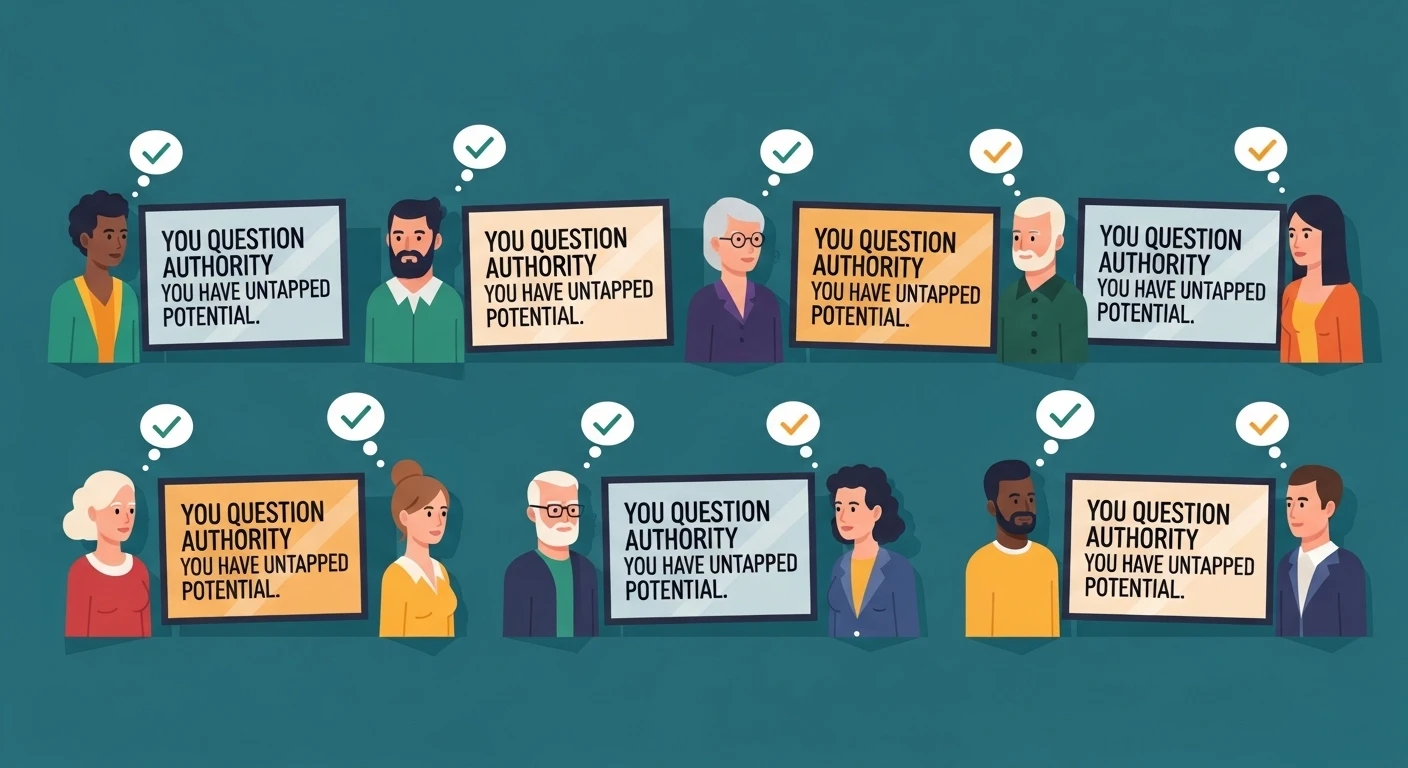
First, universal relatability. Traits like “you question authority” or “you prefer deep conversations over small talk” apply to most people. Almost everyone questions authority sometimes. Almost everyone enjoys a good conversation. These aren’t signs of intelligence. They’re signs of being human.
Second, no falsifiability. Every trait is positive or can be reframed as positive. If the list says “you’re introspective,” that’s good. If you’re not introspective, you might say “you’re observant instead.” Either way, you win. The author faces no risk of being wrong.
Third, vague specificity. Compare “you’re introspective” to actual measurable cognitive metrics. One is a feeling. The other is data. The list gives you feelings because feelings can’t be tested.
Finally, engagement optimization. The headline promises self-flattery. It says you’re already smart. You don’t need to improve. You just need to share how smart you are. This isn’t an accident. It’s designed to maximize shares and clicks.
The Swearing = Intelligence Myth
Here’s a related example. For years, media has pushed the idea that swearing means you’re more verbally intelligent. Headlines claim swear words are signs of higher IQ. This feels true because articulate people swear too. But so does everyone else.
The research doesn’t support the claim. Studies show no strong correlation between profanity use and IQ. Some research suggests the opposite in certain contexts. But correlation exploitation persists because it feels true. Our brains notice when a smart person swears. We ignore when anyone swears. This is confirmation bias in action.
The pattern is always the same: take something that feels true, add vague wording, let the reader fill in the gaps, then present it as insight.
The Gap: Why These Lists Produce Nothing
Here’s what these lists never provide: a next step. They tell you you’re smart. That’s it. No “so what” and no “now what.”
Feeling intelligent is pleasant. It feels good to be told you’re smart. But that feeling is inert. It doesn’t drive action. It doesn’t create change. It’s self-satisfaction without substance.
The confirmation bias trap makes this worse. Readers cherry-pick examples that confirm their new identity. They think “yes, I do question authority” while ignoring all the times they followed blindly. They focus on the five traits that fit and forget the twenty that don’t. The net result is self-satisfaction substituting for actual cognitive growth.
This is the real harm. Not that these articles are exactly wrong, but that they replace the work of actual improvement with the pleasure of false validation. You could spend that time learning something new. Instead, you spend it reading about how smart you already are.
What Real Intelligence Looks Like
If intelligence isn’t about feeling introspective, what is it? The research points to measurable things.
Actionable metrics include vocabulary breadth, pattern recognition speed, and working memory capacity. These can be tested. They can be compared. They can be improved through practice, though improvement has limits.
Growth indicators matter too. Learning velocity, adaptation to novel problems, and metacognitive accuracy (knowing what you know) all predict real-world success better than feeling smart.
Here’s the key distinction: intelligence is demonstrable, not feelable. You can show someone you’re intelligent through what you do. You can’t prove it through how you feel. A person who learns quickly, solves new problems, and accurately judges their own knowledge is demonstrating intelligence. A person who reads lists about being smart is just reading lists.
What these articles miss is any framework for assessment, comparison, or improvement. They offer no tests. No benchmarks. No path forward. Just a feeling that fades after you close the browser.
Breaking the Validation Loop
So how do you protect yourself from this trick? It starts with asking different questions.
Demand specificity. Question claims that could apply to anyone. If a statement fits most people, it’s not saying anything about you. Look for descriptions that would actually exclude some people.
Seek falsifiability. Look for statements that could be proven wrong. Good insight can be tested. Bad insight hides in ambiguity. If the claim can’t be wrong, it’s not useful.
Prioritize “now what.” Valid insight always creates a next step. If an article tells you something about yourself but gives you nothing to do with that information, it’s entertainment, not insight.
The shift is this: stop asking “am I smart?” Start asking “what do I do with what I know?” Intelligence that doesn’t translate to action is just potential. Potential without execution is wasted. The goal isn’t to feel intelligent. The goal is to be effective.
The next time you see a “Signs You’re Highly Intelligent” article, try this: read it and notice which traits make you feel good. Those are the Barnum traps. The rest might actually be useful. Probably not. But at least you’re looking.
The Barnum Effect isn’t going away. It’s too profitable. But you can train yourself to see it. And once you see it, the magic breaks. Those lists become what they always were: vague words designed to make you feel good about yourself, with no connection to reality. The choice is yours. Feel smart, or actually learn something.