Task-Specific Model Selection in a Converging Performance Landscape
Free models now deliver 80% of premium performance at task-specific workloads. Model selection has shifted from 'best overall' to 'best per job'—and the hierarchy is nothing like the marketing suggests.
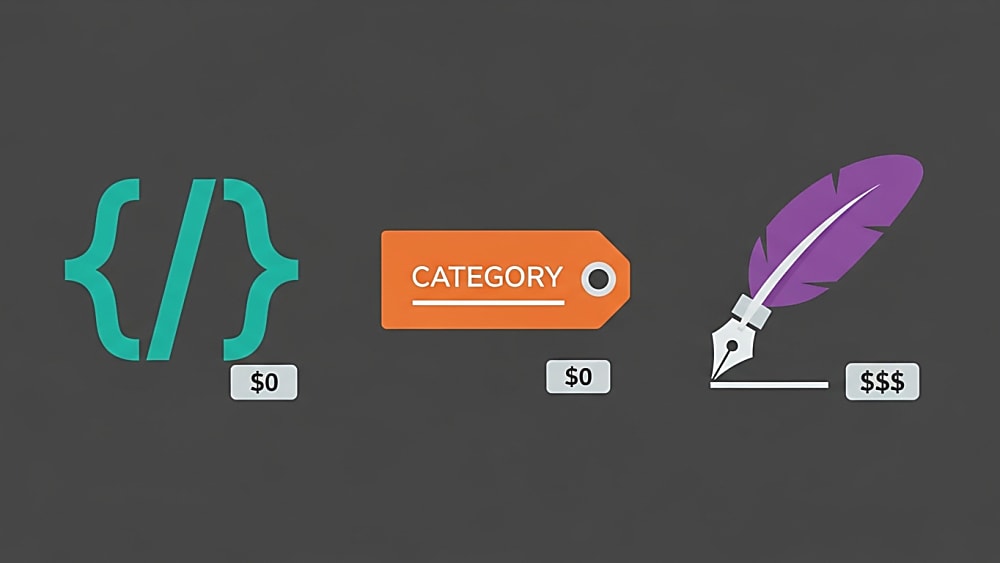
OpenRouter 2026: Task-Specific Model Selection in a Converging Performance Landscape
The Convergence No One Predicted
The AI model landscape shifted in 2025-2026, and most of the industry missed it.
Free models now run fast enough for real-time tasks. Step 3.5 generates responses at speeds comparable to premium options, removing the old excuse that free meant unusable latency. The quality gap narrowed too—not everywhere, but at specific tasks where “good enough” now comes from models that cost nothing.
Premium pricing dropped while free tiers improved. This compression changed the math. A model that costs $2 per million tokens needs to deliver more than marginal quality gains to justify itself when a free alternative handles 80% of the workload acceptably.
The question changed from “what’s the best model?” to “what’s best for this specific job?” Coding, classification, and content generation require different strengths. No single model dominates across all three. This reality conflicts with how companies market their flagship products.
Marketing departments still push “best overall” narratives that don’t match deployment patterns. Teams route different tasks to different models because testing shows the hierarchy isn’t linear. A model that excels at creative writing might stumble on structured data extraction. The brand with the biggest announcement doesn’t always deliver the best output.
Quick caveat: I’m sharing what I’ve observed through daily use, not benchmark data. Other users may reach different conclusions based on their workloads. This is subjective experience, not a controlled study—and that’s the point. Anyone can run these tests themselves.
Real-world limitation: This convergence applies to bounded, well-defined tasks. Open-ended research, complex multi-step reasoning, or highly specialized domains still favor premium models. The 80% performance claim doesn’t mean 80% across all possible uses—it means specific, common workloads where the quality difference stopped mattering.
Task-Based Model Taxonomy (Real Usage)
Models cluster by task type, not by cost or brand prestige.
Coding workloads split across complexity levels:
- Simple scripts, API integrations, and standard patterns: MiniMax M2.5 and Step 3.5 handle these reliably
- Mid-complexity debugging and refactoring: Gemini Pro shows strength in code comprehension
- Architectural decisions and complex debugging: Grok 4.1 and Sonnet justify their cost here
Classification tasks favor speed and cost efficiency:
- Step 3.5 dominates at sentiment analysis, category tagging, and binary decisions
- Trinity Large wins when classification speed determines throughput
- Premium models offer negligible accuracy gains at 5-10x the cost
Writing and content generation still show quality gaps:
- Gemini Pro and Sonnet produce more natural, context-aware prose
- MiniMax M2.5 delivers acceptable first drafts that need editing
- Cost analysis shifts when editing time factors in—cheaper output that needs rework isn’t always cheaper
Context window as a filter: Capability and context requirements come before cost in selection. A model with insufficient context length can’t complete the task regardless of price. This technical filter precedes optimization.
Cross-task variance matters more than overall rankings. A model rated “best” at one benchmark might rank fifth at your specific task. MiniMax M2.5 outperforms more expensive options at coding but trails at creative writing. Grok 4.1 handles complex reasoning but costs too much for simple classification.
Limitation: Task categories blur at the edges. “Coding” spans simple scripts to architectural design. Your mileage varies based on which part of that spectrum you occupy. Test your actual workloads, not someone else’s benchmark.
MiniMax M2.5 — The Unexpected Winner
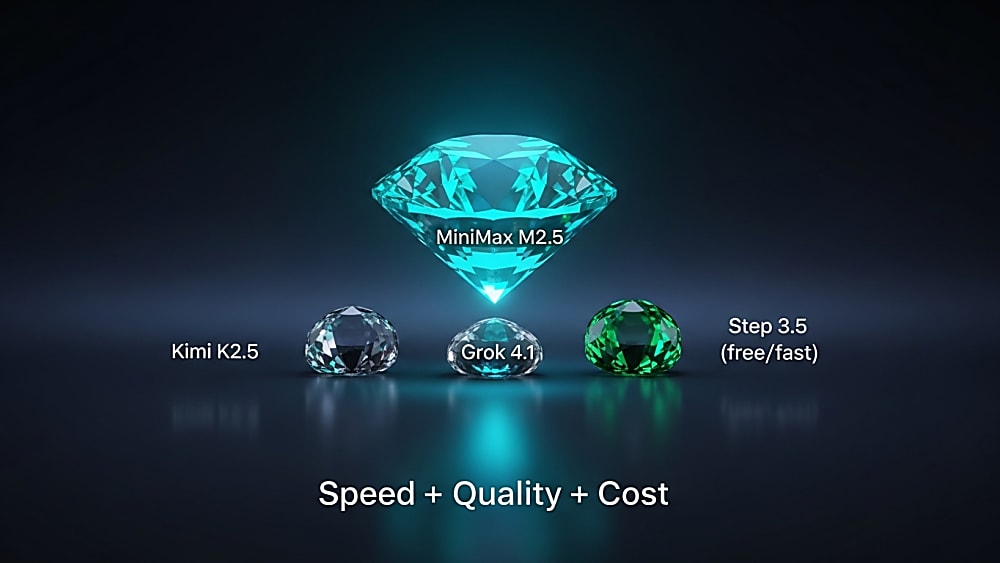
MiniMax M2.5 isn’t the most expensive option. It’s not the most promoted. But in cost-performance testing across coding and structured tasks, it consistently beats models that cost more.
Speed plus quality: Response times match or beat premium alternatives while output quality lands in the “acceptable to good” range. For coding tasks, this combination delivers better value than slower, slightly higher-quality options.
Marketing hierarchy inversion: Head-to-head testing shows MiniMax outperforming models with better brand recognition and higher price tags. Kimi K2.5 offers comparable quality at worse speed and higher cost—failing the basic value test.
Reliability factor: Consistent output without degradation across session length matters more than peak performance. MiniMax maintains quality across long conversations and complex, multi-turn coding sessions. Some premium models show variance—excellent on first response, declining on follow-ups.
Cost-performance ratio: When you normalize for quality, MiniMax delivers more usable output per dollar than alternatives marketed as superior. This isn’t “cheap and acceptable”—it’s “better value at the quality tier that matters for the task.”
Why it’s not the headline: Brand recognition. Grok and Gemini command attention through marketing budgets and parent company prestige. MiniMax lacks that cultural footprint. Developers who test multiple models discover it. Those who pick based on announcement hype miss it.
Limitation: MiniMax’s strengths concentrate in coding and structured output. Creative writing, nuanced tone control, and open-ended generation still favor Sonnet or Gemini Pro. It’s a specialist, not a generalist—but specialists win when the task matches their strength.
Step 3.5 — Free Doesn’t Mean Slow Anymore
Step 3.5 broke the old equation where free models meant unacceptable latency or quality.
Speed parity: Response times match paid models for bounded workloads. A classification task or simple code snippet generates at comparable latency to options costing $1-2 per million tokens. The old justification that “paid means fast” no longer holds universally.
Quality threshold shift: The output isn’t perfect. It’s acceptable. For tasks where “good enough” serves the purpose—sentiment tagging, category assignment, basic code structure—free delivers the needed result.
Cost arbitrage reality: When is free good enough? When the task has clear success criteria and the output meets them. When failure costs are low (a misclassified email vs. a medical diagnosis). When volume matters more than perfection (tagging 100K items where 95% accuracy suffices).
Where it fails: Complex reasoning, ambiguous instructions, or tasks requiring creativity. Step 3.5 struggles with multi-step logic, nuanced tone, and open-ended generation. It follows patterns well but breaks down when the pattern doesn’t fit.
Premium models justify cost when:
- Error rates can’t be tolerated (production code, customer-facing content)
- Task complexity exceeds Step’s reasoning capacity
- Edge cases matter more than average case performance
- The 5% quality gap costs more than the model differential
Real example: Classifying 50K customer support tickets by urgency—Step 3.5 handles this accuracy, free. Writing 50 nuanced at 93% email responses to VIP customers—Sonnet’s quality difference justifies the cost.
Limitation: Free isn’t always free—if output needs rework, editing costs count. Calculate total cost including human review time, not just model cost.
The Disappointments and Confirmations
Not every model performance matched its marketing. Some met expectations, some fell short, and niche winners emerged.
Kimi K2.5: The value failure
Comparable output quality to MiniMax M2.5, slower response times, higher pricing. There’s no cost-performance scenario where Kimi wins. It’s not bad—it’s just beaten by cheaper, faster alternatives at the same quality tier.
Grok 4.1 Fast: Meeting expectations
Reliable, good output, performs as advertised. In 2026, meeting expectations is itself notable. Grok delivers on its claims without hidden degradation or context-dependent failures. This consistency justifies use cases even when cheaper alternatives exist.
Sonnet and Gemini Pro: Narrowing advantage
Still the writing champions, but the gap shrunk. A year ago, the quality difference was dramatic. Now it’s noticeable but not always decisive. When speed or cost factors in, the calculus shifts. For final-draft content, they win. For first-draft volume work, cheaper options compete.
Trinity Large: Niche speed champion
Classification tasks at maximum throughput—Trinity Large dominates. It’s not versatile. But if you’re processing high-volume structured decisions, consider its speed-cost combination.
Benchmark vs. reality gap: Marketing emphasizes overall leaderboard rankings. Reality shows task-specific performance variance. A model ranked #1 overall might rank #5 at your specific task. The “best model” doesn’t exist—best for what is the only meaningful question.
Limitation: These assessments reflect 2026 testing at specific task types. Your task might hit different model strengths. Model updates shift the hierarchy—what’s true in February might change by June. Test continuously.
Selection Framework for 2026
Choosing models got more complex. The framework that works:
1. Start with capability and context—not cost
Can the model handle the task? Does it support required context length? Technical requirements filter first. A model that can’t complete the task isn’t a value option at any price.
2. Match task type to proven strengths
Coding ≠ classification ≠ writing. Use models that excel at your specific task type. MiniMax for coding, Step 3.5 for classification, Sonnet for writing. Don’t use a writing specialist for code generation because it’s “the best model overall.”
3. Apply cost as the third filter
After technical fit and task-specific performance, optimize for cost. Compare models that can both do the job, picking the cheaper option when quality differences don’t justify price gaps.
4. Test assumptions with real workloads
Flagship claims don’t survive contact with reality. Your task might hit edge cases where rankings flip. Run your actual prompts through multiple models, evaluate output quality for your specific use, and measure total cost including any needed rework.
5. Route intelligently across multiple models
Single model for all tasks is 2024 thinking. Use routing logic: classification to Step 3.5, coding to MiniMax, final content to Sonnet. The routing overhead costs less than putting everything through premium models.
Practical implementation:
- Define clear task categories in your workflow
- Benchmark 3-5 models per category with representative prompts
- Calculate total cost including review/editing time
- Build routing rules based on task metadata
- Re-test quarterly as models update
The human factor: All this optimization means nothing without common sense. Models don’t understand your goals—you do. Route decisions, evaluate quality, catch failures. The model is a tool. Your judgment determines whether it produces value or garbage. No amount of performance convergence changes that.
Final word: Model selection got harder because options got better. The clear hierarchy broke down. That’s progress, not confusion—but it requires you to think instead of defaulting to “the best model.” Test, measure, match task to tool, and remember that the AI’s output only matters if you apply judgment to it. The technology converged. Human common sense remains the differentiator.